

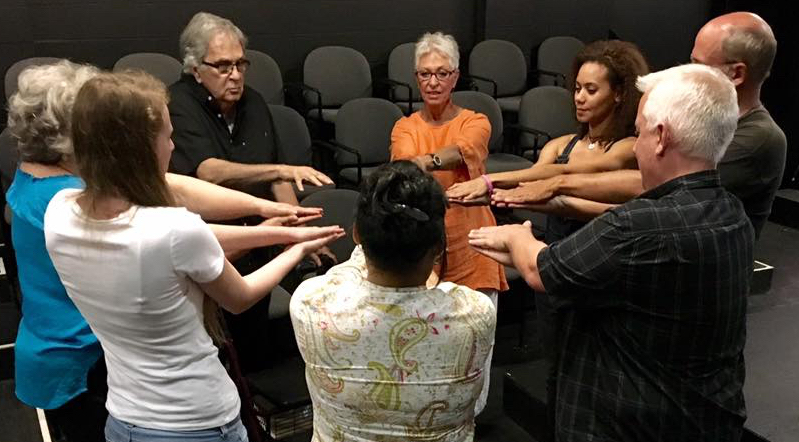
Have you ever walked into a meeting or group space to find out you’ll be participating in experiential learning? Look around the room at the faces and the body language.
Do you see clenched fists? Maybe people have started to grind their teeth a bit. Perhaps there’s even a sudden line at the rest rooms. Believe it or not, the first night of a level 1 improv class can feel just as awkward or embarrassing.
Why?
Because people don’t always feel secure or trust others when it comes to group experiences. Watching a presenter or attending training online is safe. However, when it comes to interacting as a group and pushing the comfort zone boundary, the stakes are higher. Whether you are a leader or a participant, applying a proven leadership principle—like those used at Amazon—can help you earn trust. Practice these four pieces of improv and leadership wisdom to ease discomfort and improve your group dynamics:
Show up
Yes, this seems obvious. But when we talk about showing up, we mean having a true presence. Be in the space and actively listen to your team. Stay off electronic devices. When you’re completely in the moment, you are better equipped to support others and deliver a great experience. When I host events, I often collect cell phones at the door to reinforce this foundational principle.
Communicate
If you have information that would benefit the group, share it candidly. If you see an issue, challenge it and speak candidly, but always do so respectfully. If you have neither, ask the group an open-ended question to get people connecting.
Be approachable
A smile goes a long way. I recently attended a conference and a newcomer approached me to be her partner simply because I smiled. A friendly face helps someone seamlessly transition into unfamiliar territory. Even if you hold high status, being approachable and vocally self-critical about your own missteps breaks down barriers.
Walk the talk
Once we settle into the shared experience and come out with more knowledge, don’t put it on a shelf. Whether attending corporate training or applying a new leadership principle, we must use what we’ve experienced. Only then can we start to see positive changes in our work, our communities, and ourselves.
-Amy Angelilli, Owner + Ringleader, Third Space Improv